

)
ATG Europe Joins the Einstein Telescope’s Thermal Deformations Consortium
A Leap Toward the Origins of the Universe
At PSG, our mission is built on the conviction that technology and science are not just intersecting forces, they are the very tools with which we shape a better, smarter, and more insightful world. Today, we are proud to highlight a significant milestone achieved by one of our leading engineering companies: ATG Europe. As a newly appointed member of the Thermal Deformations Consortium, ATG Europe is now playing a pivotal role in what may become Europe’s most ambitious scientific endeavor of the coming decades: the Einstein Telescope.
This announcement not only celebrates the excellence and leadership of ATG Europe in high-end engineering but also reflects the collaborative strength and interdisciplinary intelligence of the entire PSG ecosystem.
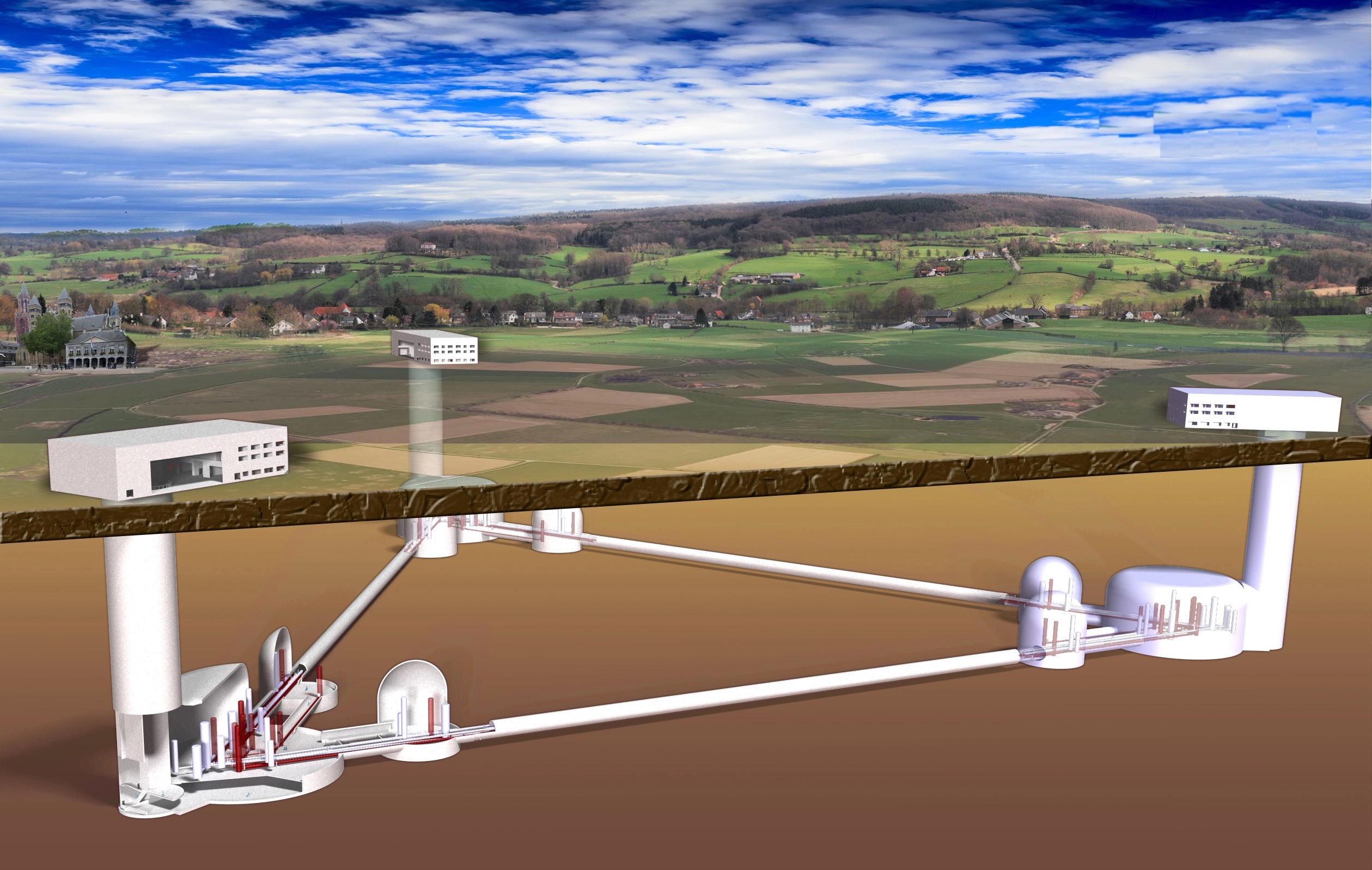 An artistic view of the proposed Einstein Telescope observatory. (Image credit: ASPERA)
The Einstein Telescope: A Gravitational Wave Observatory for the Next Generation
The Einstein Telescope (ET) represents the next evolutionary leap in gravitational wave detection. Named in honor of Albert Einstein, who first predicted the existence of gravitational waves in 1916, this observatory is not just another telescope, it is an ambitious, continent-scale scientific instrument that aims to probe the most mysterious corners of the universe. While its predecessors, LIGO (in the United States) and Virgo (in Europe), marked humanity’s first success in detecting these faint ripples in space-time in 2015, the Einstein Telescope is designed to amplify our reach by an order of magnitude, both in sensitivity and in the sheer volume of cosmic events it can detect.
Listening to the Deep Universe
Gravitational waves are created by some of the most cataclysmic and energetic events in the cosmos: the collision of black holes, the fusion of neutron stars, supernova explosions, and perhaps even echoes from the Big Bang itself. These waves pass through space virtually unimpeded by matter, making them pure messengers of ancient cosmic events. Unlike electromagnetic radiation (such as light), which can be absorbed or scattered by dust and gas, gravitational waves carry direct information about mass, motion, and gravity from their sources. Detecting them with increasing clarity means unlocking unprecedented insights into the early history and structure of the universe.
The Einstein Telescope is poised to do exactly that. Ten times more sensitive than LIGO and Virgo, ET will be capable of observing weaker signals, farther events, and subtler cosmic disturbances. It could detect hundreds of thousands of events per year, compared to the dozens currently captured by existing observatories. This would allow astrophysicists not only to study individual phenomena in greater detail but also to build statistical models of stellar evolution, black hole formation, and the nature of dark matter and dark energy.
A Revolution in Design: Triangular and Underground
What makes the Einstein Telescope radically different is not just its sensitivity, but also its architecture. Unlike LIGO and Virgo, which are L-shaped interferometers built above ground, ET will take the form of an equilateral triangle with three 10-kilometer-long arms, buried 200 to 300 meters underground. Each vertex of the triangle will house a laser interferometer — a system that splits and recombines laser beams after they’ve traveled down separate paths, detecting tiny shifts caused by passing gravitational waves.
This underground location is critical: it minimizes environmental noise from seismic activity, wind, and human interference. Moreover, the telescope will operate at cryogenic temperatures (close to absolute zero) to suppress thermal noise, allowing its mirrors and other components to remain as still and stable as technologically possible.
This design innovation is what allows the Einstein Telescope to access a lower frequency range of gravitational waves, unlocking events that current detectors are blind to — such as early inspiral phases of binary black holes, or faint signals from the deep past of the cosmos.
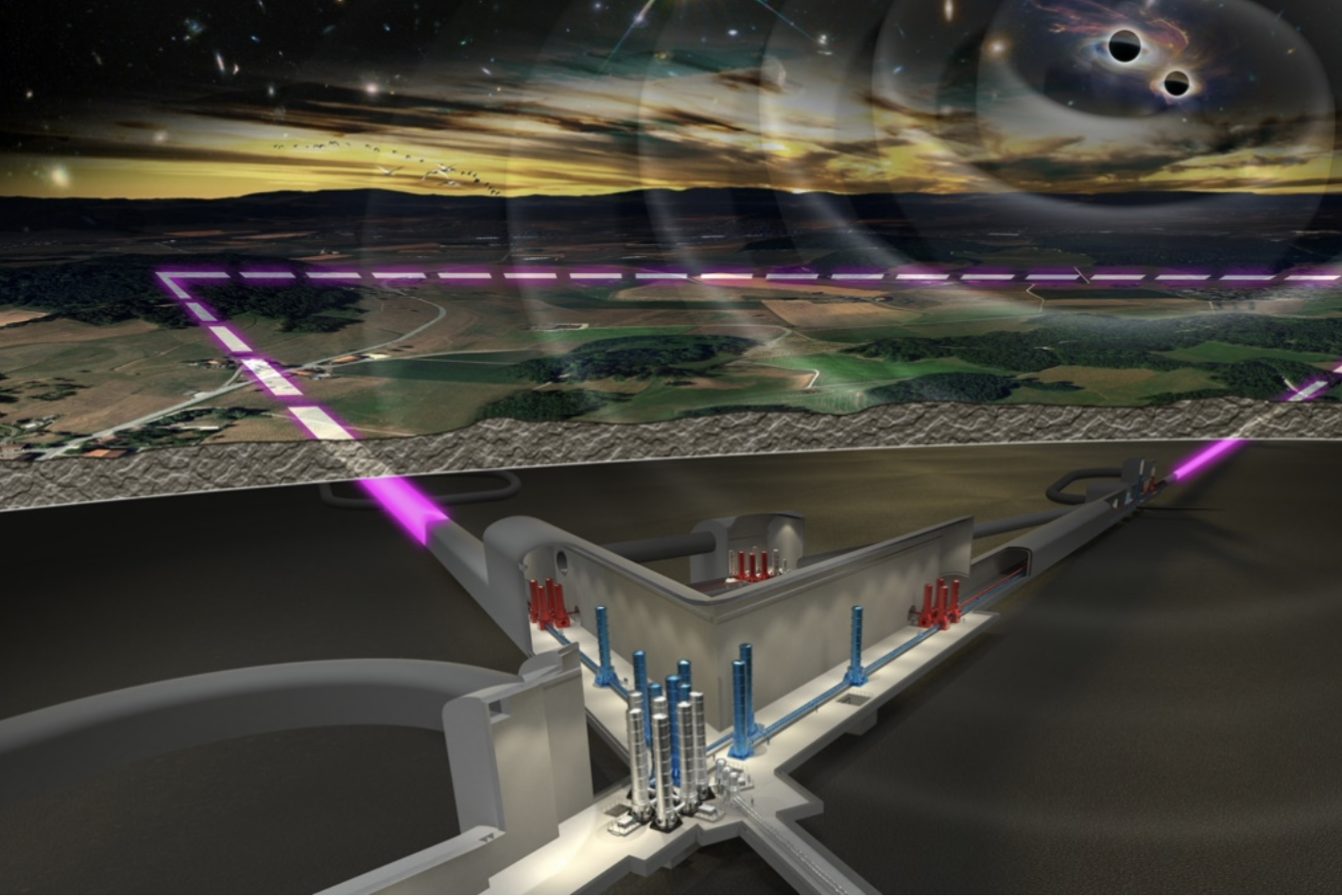 Einstein Telescope is a gravitational wave observatory that will be realized in Europe in the Euregio Meuse-Rhine border region of Belgium-Germany-Netherlands. Picture credit: Nikhef.
Scientific Objectives: Peering Into the Dawn of Time
The scientific potential of the Einstein Telescope is immense. Some of its core objectives include:
Exploring the early universe: By detecting low-frequency gravitational waves, ET could observe phenomena from the first few seconds after the Big Bang, offering insight into the origin of the universe and the laws of physics at extreme energies.
Testing general relativity: With its improved precision, ET could rigorously test Einstein’s theory in previously unreachable conditions, helping to confirm or refute our current understanding of gravity.
Understanding black hole and neutron star populations: The telescope will track thousands of compact object mergers across the universe, enabling scientists to map their distribution, formation, and evolution over cosmic time.
Probing dark matter and quantum gravity: The data collected may even contain clues to exotic physics, such as the behavior of dark matter, or possible deviations from general relativity at quantum scales.
Contributing to multi-messenger astronomy: By providing exact timings and locations of gravitational wave events, ET will enhance cooperation with other observatories (radio, optical, X-ray, neutrino), creating a multi-modal window into the universe.
A Technological Masterpiece with Unprecedented Challenges
Such a monumental project comes with extraordinary technical demands. To detect displacements smaller than the width of a proton, every component in the Einstein Telescope must be designed with unparalleled precision. The interferometers must measure variations in laser path lengths caused by gravitational waves with femtometer accuracy, while simultaneously compensating for ground vibrations, thermal noise, seismic activity, and quantum effects.
Even thermal deformations — tiny expansions or contractions in materials due to minute temperature changes — can distort the laser paths and introduce errors. That’s why the telescope’s mirrors will be cooled to cryogenic temperatures and suspended using multi-stage vibration isolation systems, and why engineering consortiums like the Thermal Deformations Consortium are essential to the mission’s success.
Tackling Thermal Deformations in the Einstein Telescope
For the Einstein Telescope to achieve its scientific goals, it must maintain absolute stability across its 10 km laser arms. At this level of sensitivity, even nanometer-level temperature fluctuations can introduce mechanical distortions, jeopardizing the fidelity of gravitational wave data.
This is where the Thermal Deformations Consortium comes into play. The consortium — one of six specialized groups formed to tackle the ET's technological challenges — is tasked with mitigating these distortions through advanced materials, simulations, design, and thermal control engineering. Composed of 26 top-tier Dutch research institutes and companies, the consortium unites minds and machines to push the limits of measurement and control.
Key partners in the consortium include: TNO, NOVA, Nikhef, Sioux Technologies, Hoursec, and Demcon — and now, ATG Europe.
ATG Europe’s Role: Turning Complexity into Precision
Founded over 50 years ago and now an integral part of PSG, ATG Europe is renowned for its deep expertise in high-performance engineering, space system development, thermal control systems, and simulation-based design.
For the Einstein Telescope project, ATG Europe's contribution revolves around:
Thermal Analysis and Simulation
Materials Engineering and Selection
Structural Engineering for Cryogenic Environments
Systems Integration and Vibration Isolation
Why ATG Europe? The Right Partner for a Global Scientific Quest
ATG Europe has contributed to ESA missions, satellite developments, planetary landers, and orbital modules, all of which demand similar (or even higher) levels of engineering precision and thermal control. This legacy provides a rock-solid foundation for working on ET's delicate systems.
From thermal dynamics to system modeling and environmental testing, ATG Europe’s approach is inherently interdisciplinary, just like the Einstein Telescope itself. The challenges at hand require engineers who understand not just one element of a system, but the interactions between multiple domains. This makes ATG a natural fit for a project defined by complexity.
In addition to technical excellence, ATG Europe brings the agility of a responsive engineering firm that can adapt quickly to new findings and prototype requirements. This is critical for projects in active research phases, where designs often evolve in tandem with new data.
Looking Forward: Engineering the First Signal from the Dawn of Time
The Einstein Telescope is not just a scientific instrument — it’s a symbol of what humanity can achieve when it thinks collaboratively and ambitiously. For ATG Europe and the PSG, this project isn’t just a client engagement. It’s a mission aligned with our very core values: Pioneering Science, Engineering Excellence, Shared Innovation.
In joining the Thermal Deformations Consortium, ATG Europe has once again shown what it means to be a leader in precision engineering. Through this achievement, PSG celebrates not just a company milestone but a group-wide commitment to enabling some of the world’s most critical scientific endeavors.
The success of ATG Europe is not an isolated win, it’s a testament to the PSG ecosystem and its philosophy of uniting science and technology under one roof.
)